
Class A vs. Class B Industrial Space in Dane County
Dane County industrial users are increasingly comparing Class A vs. Class B industrial space. The right answer depends less on the label and more on how the building affects labor, inventory, trucking, maintenance, occupancy cost, and growth.
In the Madison area, Class A industrial space generally means precast concrete or tilt-up construction, 24-foot or higher clear heights, 50-foot or better column spacing, modern docks, deeper truck courts, heavier power, better lighting, and ESFR sprinklers. Class B buildings are usually older, with metal sidewalls or older masonry, clear heights under 24 feet, fewer docks, tighter column spacing, shorter truck courts, limited trailer parking, darker interiors, and ordinary hazard sprinkler systems.
Class A buildings are not better for every user. Many Class B buildings work well for contractors, light manufacturers, service companies, showroom users, local distributors, and owner-occupants that need drive-in doors, outside storage, or a smaller footprint. A user that does not need taller clear height, trailer parking, or higher-capacity sprinkler systems may not get enough value from the premium.
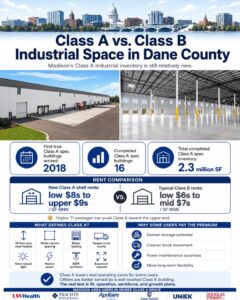
The first true Class A speculative buildings arrived in the Madison area in 2018. Before that, Class A industrial space in Dane County was largely limited to owner-occupants and build-to-suits. We now have 16 completed Class A spec buildings totaling 2.3 million square feet.
That new inventory came during an industrial expansion driven by e-commerce, reshoring, supply chain changes, and Madison-area growth. More local and regional users have embraced Class A spaces including UW Health, Trachte Building Systems, Aprilaire, Sani-matic, Uniek, and the Douglas Stewart Company.
Premium construction and modern functionality cost more. New Class A asking rents generally start in the low $8s per square foot on a triple net basis for shell space with a modest tenant improvement allowance and can reach the upper $9s as tenant improvement dollars increase. Class B buildings typically start in the low $6s and range into the mid $7s NNN, but they often include some existing office buildout and warehouse improvements.
Rent per square foot is only the first comparison. Class A spaces support taller racking, denser inventory, cleaner truck movement, lower maintenance costs, potentially lower insurance costs, and fewer near-term capital surprises. Class B space carries a lower rent, but that value may be undermined through lower storage capacity, wasted labor time, dock and lighting upgrades, power limitations, and awkward circulation.
For tenants and owner-occupants, the features should be tested against the operational needs. Clear height, loading, parking, power, office ratio, outdoor storage, truck flow, and expansion needs will determine whether the premium is useful or wasted.
For owners and investors, classification affects the leasing and sale strategy. Owners evaluating acquisition opportunities should also understand current industrial property values in Dane County before comparing Class A and Class B assets. Class A buildings can usually compete on functionality, timing, and scarcity but not all tenants can pay the freight. Class B buildings may need a realistic improvement plan, and pricing or rent that reflects both its usefulness and its constraints.
Dane County had 63.6 million square feet of tracked industrial inventory in Q1 2026, with 80,415 square feet of positive absorption and very tight 3.8% vacancy. New construction is limited outside Amazon’s large single-tenant project in Sun Prairie. One additional Class A speculative building is expected to break ground this year, and two others are possible.
Businesses evaluating industrial space should also review our article, What’s Happening in the Madison Industrial Market, for current leasing trends and supply conditions.
Many users above 20,000 square feet still have limited choices. Some will pay more for modern functionality. Others will be better served by a well-located Class B building that fits the operation.
The Class A vs. Class B industrial space distinction is useful, but the real decision is whether the building supports the next 5 to 20 years of the business, and whether the rent, improvements, and operating tradeoffs make sense.
Key Takeaways for Industrial Tenants and Owners
summary section
Choosing between Class A and Class B industrial space in Dane County involves more than comparing rental rates. Class A facilities offer modern features such as higher clear heights, expanded loading capabilities, larger truck courts, ESFR sprinkler systems, and greater operational efficiency. Class B buildings typically provide lower occupancy costs and can be an excellent fit for contractors, service companies, light manufacturers, owner-occupants, and users that do not require premium warehouse functionality.
With industrial vacancy remaining tight in Dane County and limited new construction underway, businesses must evaluate how a property’s features align with their operational needs, labor requirements, inventory management, transportation logistics, and long-term growth plans. The best industrial building is not necessarily the newest one—it’s the one that supports the business effectively over the next five to twenty years.
Dane County Industrial Space FAQs
What is the difference between Class A and Class B industrial space?
Class A industrial buildings are newer facilities with modern construction, higher clear heights, expanded loading capabilities, larger truck courts, ESFR sprinkler systems, and stronger overall functionality. Class B buildings are generally older and may have lower clear heights, fewer docks, tighter column spacing, and more limited infrastructure.
Is Class A industrial space worth the higher rent?
It depends on the operation. Companies that require higher storage density, efficient truck circulation, modern loading capabilities, and room for growth may find that Class A space offsets its higher rent through operational efficiencies. Users with simpler space requirements may find better value in a Class B facility.
What types of businesses are best suited for Class B industrial buildings?
Class B properties often work well for contractors, local distributors, light manufacturers, service companies, showroom users, and owner-occupants that need drive-in doors, outdoor storage, or smaller footprints.
How tight is the Dane County industrial market?
Dane County reported approximately 63.6 million square feet of tracked industrial inventory in Q1 2026 with a vacancy rate of 3.8%, making quality industrial space relatively limited for many users.

Chris Caulum, SIOR
Vice President of Commercial Brokerage
Chris specializes in industrial and office real estate throughout Madison and South-Central Wisconsin, helping owners, investors, and businesses make informed commercial real estate decisions.
608- 443-1040
ccaulum@oakbrookcorp.com
Meet Chris Caulum
Back to News