
Madison Industrial Sales Hit $233.8 Million in 2025
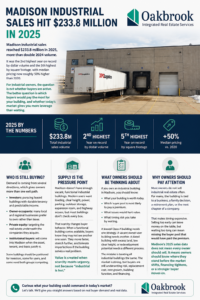
Madison industrial sales reached $233.8 million in 2025, more than double 2024 volume. It was the 2nd highest year on record by dollar volume and the 5th highest by square footage, with median pricing now roughly 50% higher than 2020.
For industrial owners, the question is not whether buyers are active. The better question is which buyers would pay the most for your building, and whether today’s market gives you more leverage than waiting.
The Big Number Needs Context
The 2025 total was helped by a major R&D and pharmaceutical acquisition by Catalent. One large deal can pull annual volume higher, but this was not a one-transaction market.
Madison also saw activity from investors, owner-occupants, private capital, and institutional buyers. A single large sale creates a headline. Multiple buyer pools create leverage.
Who Is Still Buying?
Investors are still pursuing leased buildings with durable tenancy and predictable income. Owner-occupants are still buying because many local and regional businesses would rather control their real estate than compete for limited lease options.
Private equity groups are looking at the real estate underneath the companies they acquire, and institutional buyers will still come into Madison when the asset, tenant, and basis justify it.
That gives owners more than one exit path. Some buildings should be positioned for investors, some for users, and some need both groups competing.
Supply Is the Pressure Point
Madison does not have enough vacant, functional industrial buildings. Modern users want loading, clear height, power, parking, outdoor storage, expansion room, and highway access, but most buildings do not check every box.
That scarcity changes buyer behavior. When a functional building comes available, buyers know they may not see another one soon. They move faster, stretch further, and tolerate imperfections if the building solves a real problem.
Value is created when scarcity meets urgency, not because “industrial is hot.”
What Owners Should Be Thinking About
If you own an industrial building in Madison, you should know what it is worth today, which buyer pool is most likely to pay a premium, what issues would hurt value, and what timing risk you take by waiting.
A leased Class A building needs one strategy. A vacant owner-user building needs another. A dated building with excess land, low clear height, or redevelopment potential needs a different process.
The mistake is treating all industrial buildings the same. The market is strong, but buyers are still underwriting risk, replacement cost, rent growth, building function, and financing.
Why Owners Should Pay Attention
Most owners do not sell industrial real estate often. For many, the building is tied to a business, a family decision, a retirement plan, or the next chapter of a company.
That makes timing expensive. Selling too early can leave money on the table, but waiting too long can mean missing the buyer pool that would have paid the premium.
Madison’s 2025 sales data does not mean every owner should sell. It means owners should know where they stand before the market shifts, financing tightens, or a stronger buyer moves on.
Bullet Summary
- Madison industrial sales reached $233.8M in 2025, more than doubling 2024 activity
- The year ranked 2nd highest on record by volume and 5th by square footage
- Median pricing has climbed approximately 50% since 2020
- A large R&D/pharma transaction (Catalent) contributed to totals, but activity was not isolated
- Buyer depth remains strong across investors, owner-users, private capital, and institutions
- Owners today have multiple viable exit paths, not just one
- Functional vacancy remains limited, especially for modern industrial requirements
- Scarcity is driving faster decisions and more aggressive buyer behavior
- Buyers are prioritizing utility over perfection, accepting flaws when the building solves a need
- Value is being driven by supply constraints and urgency—not market sentiment alone
- Outcomes depend on how well a property is positioned for the right buyer pool
- The key decision is no longer if demand exists, but when and how to capture it
FAQ Section
What does the 2025 sales volume actually signal?
It confirms that capital is active in Madison, but more importantly, it shows that multiple buyer groups are competing for limited opportunities—which creates leverage for sellers.
How much did the Catalent transaction impact the numbers?
It elevated total volume, but it does not fully explain the market. The presence of consistent activity across buyer types is what defines the strength of 2025.
Is buyer demand still broad or becoming selective?
Both. Demand is broad across buyer types, but capital is disciplined—pricing premiums are reserved for assets that meet specific operational or investment criteria.
What types of properties are seeing the strongest demand?
- Leased buildings with stable income (investor-driven)
- Functional buildings for owner-users
- Assets with clear utility, even if not perfect
- Select redevelopment or repositioning opportunities
Why is supply such a constraint right now?
Madison lacks available buildings that meet modern industrial standards. This mismatch between supply and user requirements is driving competition and pricing.
How are buyers behaving in this environment?
Buyers are:
- Moving more quickly
- Expanding pricing expectations
- Accepting functional trade-offs
- Competing more directly across buyer types
Does a strong market mean every owner should sell?
No. The takeaway is not to sell—it is to understand your building’s position in today’s market and identify where leverage exists.
What factors most impact value today?
- Building functionality and specifications
- Income stability or user demand
- Location and access
- Replacement cost dynamics
- Alignment with the most competitive buyer pool
What is the risk of waiting?
Market conditions can shift—particularly financing, supply pipelines, or buyer priorities. Waiting introduces the risk of missing the most aggressive buyer pool.
What should owners be doing right now?
Owners should be evaluating:
- Current market value
- Likely buyer profiles
- Property-specific risks
- Timing strategy

Chris Caulum, SIOR
Vice President of Commercial Brokerage
Chris specializes in industrial and office real estate throughout Madison and South-Central Wisconsin, helping owners, investors, and businesses make informed commercial real estate decisions.