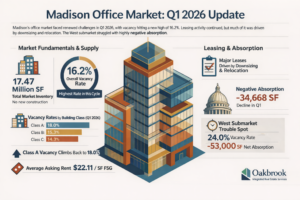
The Madison office market reached 16.2% vacancy in Q1 2026, the highest we’ve seen this cycle.
The all-time high came after the Great Recession in 2009, when we peaked at 17.3%.
That headline number gets attention, but the real story is what impact it has on every negotiation.
Prior to Covid, Madison office landlords had real leverage. Vacancy bottomed out at just 7.8% in 2017 and it was still under 10% at the end of 2019.
If You Signed Your Lease Prior to 2020, You’re Probably Overpaying
Most office leases are five years or more so many Madison area companies signed their leases in a very different market.
Today, landlords are underwriting deals more aggressively just to keep occupancy up. Tenants are getting:
Lower face rates
More free rent
Larger TI packages
More flexibility on options
If You Own Office, Brace for Impact
Not all pockets of the market and classes of buildings are distressed, but most landlords will have a struggle on their hands when a tenant comes up for renewal or a space needs to get backfilled.
Well-located, well-capitalized buildings with nice amenities are still competing—and in many cases, winning. But with so many available spaces, Tenants tend to have multiple options to cause landlords to compete for them.
Some owners have adjusted to the new reality, but most seem to be holding onto pricing or terms that may not be attainable in this market. Others are beginning to evaluate whether redevelopment may provide a stronger long-term outcome.
If you have debt, pay close attention to your loan maturity and try to prepare well in advance. It may take a year or two to get back to stabilization.
If You’re Lending on Office, Underwriting Assumptions Should be Scrutinized
The overall market is at 16.2% vacancy, but certain submarkets and classes of space are much higher. At the same time, there may be little to no current vacancy in the subject building. So setting the appropriate vacancy allowance isn’t easy.
Perhaps the bigger question is: what should you assume when leases are set to expire in the near term?
Backfilling space is taking longer, costing more, and often resetting rents after concessions. That puts pressure on cash flow in a way we haven’t seen in several years.
Some assets will work through it. Some won’t—at least not without new capital or a different strategy.
Madison’s Office Market Will Get Better
If vacancy is going to rise further, I don’t think it peaks much higher. We have seen a slowing of the rise in the last 18 months.
If you want to see where the opportunities are – by submarket, building type, or lease profile, please reach out to me or members of the Oakbrook team.
This analysis is based on Oakbrook market research, CoStar data, REDI market reports, and local transaction tracking through Q1 2026. Vacancy, absorption, and leasing trends reflect the Madison office market as of the end of the first quarter of 2026. Figures may be revised as source databases are updated. Commentary reflects our interpretation of how those conditions are affecting tenants, owners, lenders, and investors.
Frequently Asked Questions
Q: What is the Madison office vacancy rate in Q1 2026?
A: Madison office vacancy reached 16.2% in Q1 2026, the highest level in the current cycle.
Q: Are office tenants in Madison gaining leverage?
A: Yes. Higher vacancy has increased tenant leverage in many negotiations, including face rates, free rent, tenant improvement packages, and flexibility on options.
Q: What does this mean for Madison office building owners?
A: Owners may face more pressure on renewals, backfilling space, concessions, and loan maturity planning, especially in weaker submarkets or less competitive buildings.
Q: Is the Madison office market recovering yet?
A: The article’s view is that conditions may improve over time, but current vacancy and leasing dynamics still reflect pressure rather than a full recovery.
Chris Caulum, SIOR
Vice President of Commercial Brokerage
Chris specializes in industrial and office real estate throughout Madison and South-Central Wisconsin, helping owners, investors, and businesses make informed commercial real estate decisions.