
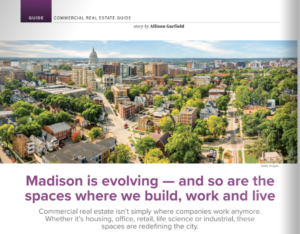
What I’m Seeing in Madison Commercial Real Estate in 2026
In Business Madison recently interviewed me and several others working in local commercial real estate for its September feature, Madison is evolving, and so are the spaces where we build, work and live. Read the In Business Madison feature
The article covers office, industrial, life science, housing and development.
Several of the issues discussed are the same ones coming up every week in conversations with owners, tenants and companies looking for space.
1. Office vacancy is still rising
Madison has held up better than many larger Midwest office markets. The local numbers, however, are still moving in the wrong direction.
Overall office vacancy increased to 16.3% in Q2 2026, with 36,500 square feet of negative net absorption during the quarter. The weakness remains concentrated in the suburbs. Suburban Class A vacancy reached 22.1%, while west-side Class A vacancy was 31.6%. Our Q2 2026 Madison Office Market Update goes deeper into the numbers and what they mean for owners and tenants.
Downtown Class A is a different story, with vacancy at 10.6%. Class B buildings also posted 33,800 square feet of positive absorption in Q2. But the amount of suburban space available means owners are still competing for a limited number of active tenants.
Tenants have leverage, particularly on the west side. For owners, building condition, suite quality, economics and responsiveness can determine which properties make the short list.
2. Industrial users still have very few choices
Madison’s industrial vacancy rate declined to 3.3% in Q2, while the market recorded 323,700 square feet of positive net absorption.
A 3.3% vacancy rate sounds tight. In practice, many searches are tighter than that.
A company looking for 20,000 to 100,000 square feet may need a specific combination of clear height, loading, electrical capacity, parking, truck circulation, zoning, office buildout and location. As we discuss in our article on Class A versus Class B industrial space in Dane County, the label matters less than whether the building actually works for the operation.
Apply those requirements to the available inventory and the list can get short quickly.
Our team maintains a database of more than 800 industrial buildings throughout the Madison area and regularly searches properties that are not formally listed. On some assignments, we still find only a handful of buildings with the right size and characteristics.
That scarcity changes the choices companies have to make. Sometimes an existing building can save substantial time and money even if it requires modifications. Other times, the search confirms that a realistic existing-building option probably does not exist. We recently looked at that decision in Why Some Industrial Users Choose Existing Buildings Over New Construction.
The shortage is also pushing more industrial growth toward Sun Prairie, DeForest, Cottage Grove and other communities with available land and newer inventory. Companies with an approaching lease expiration or expansion should be evaluating alternatives well before the need becomes urgent.
3. Dane County needs places for employers to grow
The In Business article also discusses industrial land. I see that as a practical constraint on future growth.
Industrial development needs suitable zoning, infrastructure, road access and land that works physically for the project. Those sites are difficult to create after surrounding areas have already developed around other uses.
Dane County continues to add housing, and communities are making long-term decisions about how remaining land will be used. Housing demand gets much of the public attention. Employers still need places to manufacture products, store inventory, distribute goods and expand their operations.
Once industrial land is committed to another use, replacing it can be difficult. For business owners, that can eventually mean fewer site choices, higher land costs or locations farther from employees, customers and existing operations.
The imbalance between the office and industrial markets is hard to miss. An office tenant can usually compare several credible alternatives. An industrial company may start a search and discover that only a few buildings actually work. How much industrial land communities preserve for future development will have a lot to do with whether that changes.
The full In Business Madison feature includes perspectives from people working across development, brokerage, architecture and economic development in the region. It provides a broader look at the issues affecting Madison commercial real estate today. Read the full In Business Madison article
Summary
Madison’s commercial real estate market continues to show contrasting trends in 2026. Office vacancy is rising, particularly in suburban Class A properties, while industrial space remains limited. Chris Caulum examines what these conditions mean for owners and tenants, the challenges facing expanding businesses, and why preserving industrial land is important for Dane County’s future growth.
Frequently Asked Questions
1. What is the office vacancy rate in Madison in 2026?
Madison’s overall office vacancy rate reached 16.3% in Q2 2026. Suburban Class A properties continue to face higher vacancy, particularly on the west side, while downtown Class A buildings have maintained lower vacancy rates.
2. Why is industrial space difficult to find in the Madison area?
Madison’s industrial vacancy rate was just 3.3% in Q2 2026. Businesses often need specific building features, including adequate clear height, loading access, electrical capacity and suitable zoning. These requirements can significantly reduce the number of available properties that meet their operational needs.
3. Why is preserving industrial land important for Dane County?

Chris Caulum, SIOR
Vice President of Commercial Brokerage
Chris specializes in industrial and office real estate throughout Madison and South-Central Wisconsin, helping owners, investors, and businesses make informed commercial real estate decisions.
608-443-1040
ccaulum@oakbrookcorp.com
Meet Chris Caulum