
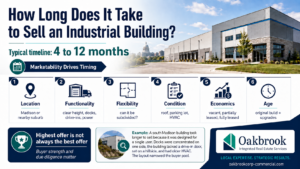
How Long Does It Take to Sell an Industrial Building?
How long does it take to sell an industrial building? Most Madison-area industrial owners should plan on 4 to 12 months from serious preparation to closing, with some phases overlapping.
That timeline can affect carrying costs, business planning, loan payoff, relocation timing, 1031 exchange planning, and how timing aligns with the Madison industrial sales market.
Timing usually comes down to marketability, pricing, buyer depth, financing, due diligence, and how organized the seller is before launch.
Start With Marketability
Location sets the first filter. Buildings in the City of Madison or a nearby suburb usually draw a deeper buyer pool than buildings farther out, depending of current Madison industrial conditions assuming the price and features are reasonable.
Building functionality is next. Buyers look at ceiling height, dock doors, drive-in doors, column spacing, power, sprinklers, truck court depth, parking, outside storage, and prior expansions. Repeated additions can create awkward sections that fit one user but limit the next buyer.
Flexibility affects both price and timing. Can the building be subdivided? Does it have separate metering? Are docks and drive-in doors dispersed or concentrated? Does parking line up with the entrances? A flexible building can appeal to more users. A rigid building needs the right buyer.
Condition and age drive negotiation. Roof, parking lot, HVAC units, sidewalls, concrete, dock equipment, original construction date, additions, and system upgrades will all be evaluated.
Economics shape the buyer pool. Vacant buildings may appeal to owner-users. Fully leased buildings may appeal to investors. Partially leased buildings can work for both, depending on leases, rents, rollover, and remaining space, and the sale vs. reinvestment decision. Rental rates, capital expenditures, and interior remodeling needs affect value.
Example: Why One Building Took Longer
We sold a south side Madison industrial building that was well located but designed for a single user. Docks were concentrated along one side, which made subdivision difficult. The building was front-loaded, lacked a drive-in door, was built into a hillside, and had older HVAC equipment.
The likely buyer pool in that business park included smaller users who liked the location but could not occupy the full building. Once they studied the layout, the lack of flexibility caused several to pull back.
An owner expecting a quick sale would have misread the building. The location was good, but the layout reduced the number of buyers who could actually use it.
The building sold, but the marketing period took longer and the layout narrowed the buyer pool.
The Sale Timeline
A practical timeline usually looks like this:
Pre-sale preparation: 1 month
Marketing and buyer selection: 2 to 6 months
Contract to closing: 2 to 5 months
Preparation includes gathering leases, rent rolls, operating expenses, surveys, title information, environmental reports, roof history, maintenance records, building plans, and basic physical details so the building can be valued correctly. The listing contract is then drafted and signed.
Marketing depends on buyer depth. A clean, functional warehouse in a strong location can attract attention quickly. A specialized building with limited loading, low clear height, heavy office buildout, environmental history, or unusual layout will usually take longer.
Pricing also influences the timeline. If speed is not the primary goal, some sellers choose to start near the upper end of a defensible pricing range and measure buyer response. That can work, but it usually adds time.
Vacant, leased, and partially leased buildings attract different buyers. Owner-users care about occupancy timing, layout, loading, power, parking, and improvement cost. Investors care about tenant credit, rent level, lease term, rollover risk, and future capital needs.
Offers and Due Diligence
It is rare to get multiple offers at once. In those cases, sellers should look beyond price.
Earnest money, inspection periods, financing contingencies, environmental contingencies, proof of funds, lender relationship, closing timeline, and the buyer’s track record are all key variables.
The right buyer is the one with the price, capital, lender support, diligence discipline, and motivation to close. A weak buyer can tie up the property, miss deadlines, extend due diligence, and then try to renegotiate.
After an offer is accepted, due diligence often controls the schedule. Buyers may need a Phase I environmental report, lender approval, appraisal, survey, title review, inspections, zoning confirmation, and tenant estoppels. Title, survey, zoning, and lender issues all take time to examine.
Environmental review deserves special attention in industrial real estate. Prior manufacturing, vehicle repair, chemical storage, floor drains, underground tanks, neighboring uses, and old records can create follow-up questions.
Many owners do not have full building plan sets, MEP drawings, a title policy, or a current survey readily available. Buyers notice. Missing information gives them room to slow the process, discount the price, or reopen negotiations after the property is tied up.
Final Thought
Sales usually move faster with realistic pricing, and a clear understanding of industrial property values in Madison, complete records, clean title, known condition, current lease information, a recent environmental report, and a responsive seller.
Industrial owners should start preparing before they need to sell. Understand value, organize the property file, identify buyer objections, and decide what should be fixed before launch.
Key Takeaways
-
Madison area industrial owners should generally plan on 4 to 12 months from preparation to closing.
-
Location, functionality, flexibility, condition, economics, and age drive buyer demand.
-
A well-located building can still take longer to sell if the layout limits the buyer pool.
-
Buyer selection affects timing. The highest offer is not always the offer most likely to close.
-
Environmental review, title, survey, zoning, lender underwriting, and inspections often control the closing schedule.
-
Missing documents give buyers room to slow the process, reduce price, or reopen negotiations.
-
Owners should start preparing before they need to sell.
Industrial Building Sale FAQs in Madison, WI
How long does it take to sell an industrial building in Madison?
Most Madison area industrial owners should plan on 4 to 12 months from serious preparation to closing. Some buildings sell faster, but specialized buildings, over-priced assets, environmental questions, financing issues, or incomplete documentation can extend the process.
What makes an industrial building easier to sell?
Industrial buildings are easier to sell when they have a strong location, functional loading, adequate clear height, good truck circulation, enough parking, flexible layout, clean title, known building condition, and complete property records.
Why do some industrial buildings take longer to sell?
Some buildings have a smaller buyer pool. Common issues include limited dock loading, no drive-in door, low clear height, heavy office buildout, older HVAC systems, awkward additions, poor truck access, deferred maintenance, or a layout that cannot be easily subdivided.
Does a vacant industrial building sell faster than a leased building?
Not always. A vacant building may appeal to owner-users who need occupancy, but investors may prefer leased income. A leased building can attract investors if the tenant, rent, lease term, and rollover risk are strong. The buyer pool changes based on occupancy.
What documents should an owner gather before selling an industrial building?
Owners should gather leases, rent rolls, operating expenses, surveys, title information, environmental reports, roof history, maintenance records, building plans, MEP drawings, utility information, and basic physical details such as clear height, loading, power, parking, and zoning.
What happens during due diligence on an industrial sale?
Buyers typically review environmental conditions, title, survey, zoning, building condition, roof, HVAC, leases, financing, appraisal, and tenant documents. Industrial due diligence often takes longer when there are prior manufacturing uses, floor drains, chemical storage, underground tanks, or old environmental records.
Should an owner fix building issues before going to market?
Some issues should be fixed. Others should be disclosed and priced correctly. The key is knowing which problems will affect value, financing, buyer confidence, or timing before the buyer discovers them.
Is the highest offer always the best offer?
No. Sellers should also evaluate earnest money, inspection periods, financing contingencies, environmental contingencies, proof of funds, lender relationship, closing timeline, and buyer track record. A weak buyer can tie up the property and then retrade after due diligence.

Chris Caulum, SIOR
Vice President of Commercial Brokerage
Chris specializes in industrial and office real estate throughout Madison and South-Central Wisconsin, helping owners, investors, and businesses make informed commercial real estate decisions.
608 443-1040
ccaulum@oakbrookcorp.com
Meet Chris Caulum