
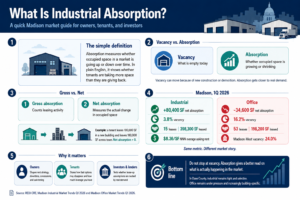
What Is Industrial Absorption?
Vacancy gets most of the attention. Absorption tells you more.
Industrial absorption measures whether occupied industrial space is increasing or decreasing over time. In plain English, it shows whether tenants are taking more space than they are giving back.
Not what’s listed. Not what’s available. What’s actually occupied.
That is the number owners, tenants, investors, and lenders should watch when they are trying to read market direction.
In Q1 2026, Dane County’s industrial market posted 80,400 square feet of positive absorption and held vacancy to 3.8%. The office market moved the other way, with 34,600 square feet of negative absorption and vacancy at 16.2%.
Same metric, two very different stories.
Vacancy vs. Absorption
Vacancy tells you what is empty today. Absorption tells you whether occupied space is growing or shrinking.
A new 200,000 square foot building can be developed completely empty. Vacancy rises, but absorption does not change unless a tenant moves in or out. Flip it around. A vacant 50,000 square foot building can be demolished. Vacancy improves, but absorption still does not change. No tenant occupied more space.
That is why vacancy alone can fool you. It moves because of construction, demolition, or inventory changes. Absorption gets closer to actual demand.
Gross Absorption vs. Net Absorption
Gross absorption counts leasing activity.
Net absorption measures whether the market actually gained or lost occupied space.
A tenant signs a 100,000 square foot lease in a new building and walks out of 100,000 square feet across town. The landlord with the new lease is happy. But the market gained nothing. Net absorption is still zero.
For market analysis, net absorption is the number worth paying attention to.
Why It Matters in Dane County
The Q1 2026 industrial numbers show a market still absorbing space. Madison industrial recorded 15 lease transactions totaling roughly 398,300 square feet. Average asking rent increased to $8.36/SF NNN from $8.10 a year earlier.
That supports the story most active tenants already feel. Functional industrial space is limited, especially buildings with clear height, dock loading, adequate power, truck circulation, and yard area.
Positive absorption does not save every building though. Older low-clear buildings with awkward loading, heavy office buildout, or poor truck access can still sit on the market. That is where the Class A vs. Class B split becomes real.
Office tells the opposite story. Madison office had 53 lease transactions in Q1 2026, but still lost occupancy. Madison West alone posted 52,900 square feet of negative absorption and ended the quarter at 24% vacancy. Leasing activity did not fix the occupancy problem.
The Bottom Line
Absorption is the market’s occupancy scorecard.
For owners, it affects rent, downtime, concession strategy, sale timing, and whether capital improvements are worth making.
For tenants, it tells you how much runway you have and how much leverage you’re really working with.
For investors and lenders, it stress-tests whether lease-up assumptions are grounded in actual demand or wishful underwriting.
In Dane County, absorption is currently telling two different stories. Industrial is tight and the bench for functional options isn’t deep. When something good comes available, it doesn’t last long. Office remains under pressure and increasingly building-specific.
If you are making a lease, sale, purchase, or reinvestment decision, do not stop at vacancy. Absorption will give you a better read on what is actually happening.
If your lease is coming up, your company is growing, or you are trying to understand what your building is worth in the current market, reach out. We work the Dane County industrial and office market every day and can give you a straight read on where things stand.
Key Takeaways
- Absorption measures the change in occupied space over time, not what’s listed or available
- Vacancy and absorption can move in opposite directions and mean completely different things
- Net absorption is more useful than gross absorption because it accounts for space given back
- Positive absorption supports rents and landlord leverage; negative absorption shifts power to tenants
- In Dane County right now, industrial is tight and functional options are limited; office is under pressure and increasingly building-specific
FAQ
What is industrial absorption?
The change in occupied space over a given period. Positive means tenants took more than they gave back. Negative means the opposite.
What is the difference between gross and net absorption?
Gross counts leasing activity. Net accounts for space vacated at the same time. Net is the more useful number.
Can absorption be positive while vacancy is rising?
Yes. If a new building delivers vacant, vacancy rises but absorption doesn’t move. They measure different things.
What does positive absorption mean for tenants?
Fewer options and less leverage. In a tight market, start your search earlier than feels necessary.
Does strong leasing activity mean the market is healthy?
Not always. Madison office had 53 transactions in Q1 2026 and still lost occupancy. Activity and absorption are not the same thing.

Sean Ruhly
Commercial Real Estate Associate
Sean Ruhly works with business owners, investors, tenants, and developers on office, industrial, and land real estate throughout Southern Wisconsin. His work includes sales and leasing support, market research, site selection, property analysis, and transaction execution.
Sean closely tracks local market activity, development trends, leasing, sales, and user demand to help clients make informed real estate decisions.
608- 838-3100
sruhly@oakbrookcorp.com
Meet Sean Ruhly