
Why Some Madison Office Buildings Are Becoming Redevelopment Sites
When Office Buildings Are Worth More as Dirt
Key Takeaways
- Some Madison office buildings are now worth more as redevelopment sites than office assets.
- In 2024 and 2025, 17 office buildings sold for redevelopment or conversion.
- Those sales represented 25% of Madison office sales and roughly 210,000 square feet of inventory.
- Redevelopment is removing obsolete office space and creating new housing, hospitality, entertainment, and mixed-use projects.
- For owners, the key question is whether the land is worth more than the building.
The First Question Has Changed
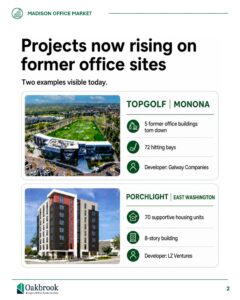
Recent Madison Office Redevelopment Examples
Five former office buildings were demolished for a new entertainment use.
Developer: Galway Companies
A new 70-unit supportive housing development is replacing obsolete office space.
Developer: LZ Management
A 309-unit apartment project is replacing outdated office buildings.
Developer: Vermilion Development
A 244-unit apartment community was built on a former office site.
Developer: Galway Companies
Why Owners, Investors, and Developers Should Care
Frequently Asked Questions
Some older office buildings no longer support enough rent, occupancy, or investor demand to justify continued office use. In those cases, the land may be more valuable for another use.
How many Madison office buildings sold for redevelopment or conversion in 2024 and 2025?
Seventeen office buildings sold for redevelopment or conversion, representing 25% of Madison office sales and roughly 210,000 square feet of inventory.
Does redevelopment help Madison’s office vacancy rate?
Yes. Madison’s office vacancy rate is 16.2%. Removing obsolete office buildings from the inventory helps keep vacancy from moving even higher.
What should office building owners evaluate before selling?
Owners should look beyond current income. Location, zoning, future land use, surrounding development, and land value may all affect pricing.
What types of projects are replacing older office buildings in Madison?
Recent examples include apartments, supportive housing, hospitality, entertainment, and mixed-use projects.
This analysis is based on Oakbrook Corporation’s review of Madison-area office sales activity in 2024 and 2025, including properties identified as redevelopment or conversion candidates. Vacancy data reflects Madison office market conditions as tracked through Oakbrook’s internal market research and third-party market data sources.
Author, Chris Caulum

Chris Caulum, SIOR, CCIM
Commercial Real Estate Advisor | Oakbrook Corporation
Chris Caulum advises owners, occupiers, investors, and developers on industrial and office real estate across Greater Madison and Dane County. His work includes sales, leasing, acquisitions, dispositions, site selection, and market strategy.
Chris tracks local leasing, sales, vacancy, construction, and user demand to help clients make better real estate decisions.
Back to News